A supply chain scientist combines decision science, data science, artificial intelligence and business knowledge to make decisions that move atoms, meaning things in the real world. What they do, where they work and how to become one.
When we started studying how some of the most advanced companies in the world solved supply chain problems, we kept running into a term that, at least for us, was almost unheard of where we work: supply chain science. And the role that practises it, the supply chain scientist.
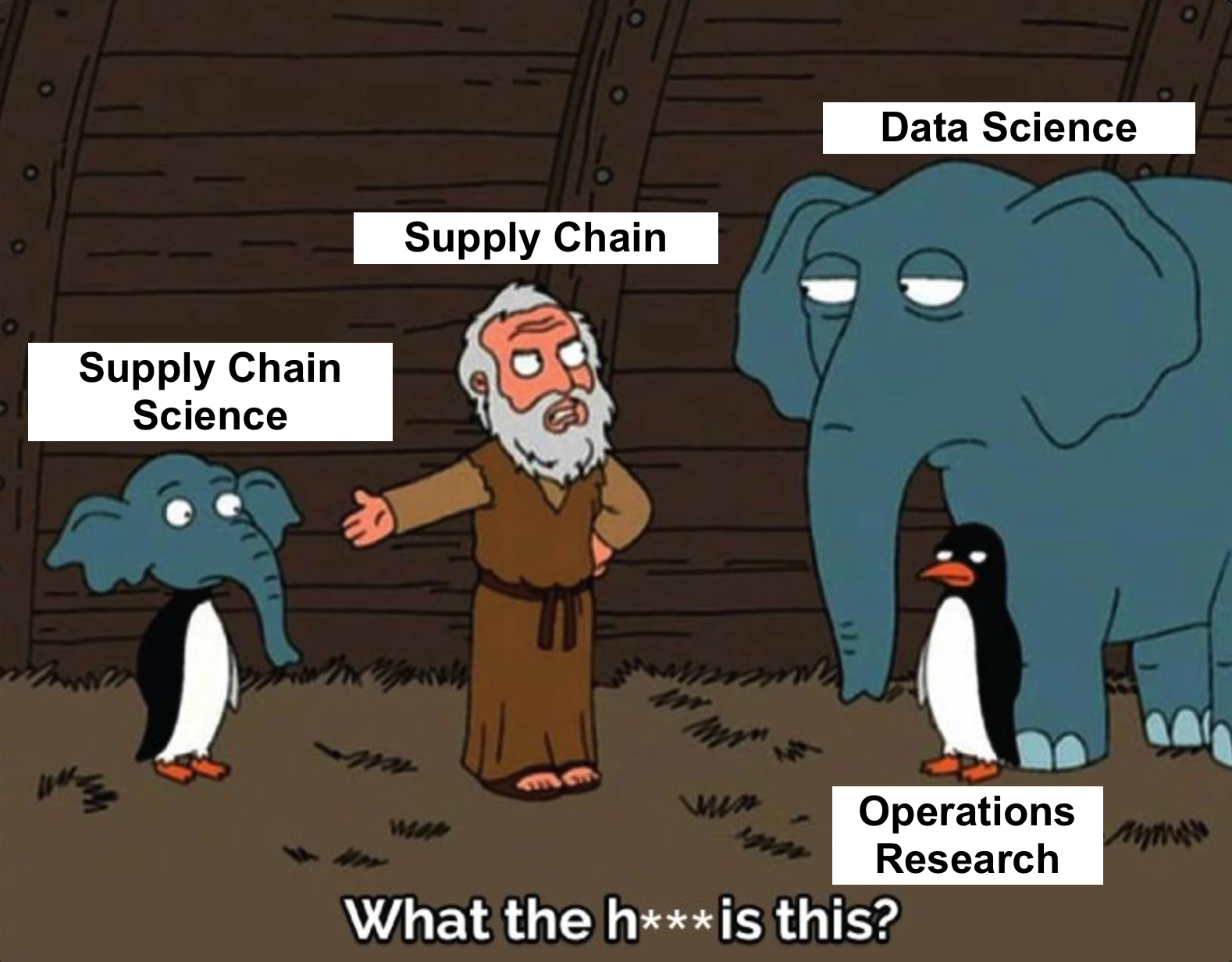
Our first thought was that it was a fancy rebrand of data science. But it grew on us, because it brings under one umbrella a lot of things that companies often look at separately, and that we believe need to be handled together.
What a supply chain scientist does
In short, a supply chain scientist uses quantitative models to make supply chain decisions: how much to buy, how much stock to hold, what to produce first, how to plan the routes, and much more.
Supply chain science
The discipline that combines decision science (operations research), data science, artificial intelligence and business knowledge to make supply chain decisions.
As with almost everything these days, artificial intelligence and machine learning are part of it. The difference is that here everything ends in a decision that moves atoms in the real world: a purchase order ends up as boxes arriving at a warehouse, a production schedule takes up machines and people, a route puts trucks on the street. If the decision goes wrong, there is excess stock or products missing from the shelf, and that shows up pretty quickly.
That is why we like to think of it as decision science. In this world, estimating what will happen is half the job. The other half is deciding what to do with that prediction, turning it into a decision about budget, capacity, deadlines or anything else that has an impact in the real world.
What it is made of
We think of it as three areas resting on the same base.
- Decision science and operations research. Optimisation, simulation and decision theory. It is what lets you choose, among thousands of possible options, the one that best meets the operation’s constraints.
- AI, data science and machine learning. Statistics and models to estimate what you cannot see at a glance: demand, how much it varies, how long goods take to arrive. And more and more, AI agents that take care of much of the technical work around those models and bring into the process information that today lives in emails and meetings.
- Supply chain and business knowledge. Understanding how the operation really works: how long each supplier actually takes, how each category moves over the year, which products can never run out, and what the planner corrects and why.
At the bottom sits the base, analytics and data engineering. Without clean, up-to-date data, nothing else gets going.
Finding all of this in one person is pretty hard. It is usually split across several teams that do not always talk to each other, and we believe there is a need for a profile that covers all these angles and can own these processes end to end.
Where it is applied
There are as many use cases as there are supply chains in the world. Some of the ones we come across often are these:
- Forecasting: how much of each product will sell, where and when.
- Inventory: how much stock to hold and when to replenish.
- Purchase optimisation: how to share out a budget, a warehouse or a supplier’s capacity across thousands of products.
- Routing: which truck goes to each customer and in what order.
- Scheduling: what gets produced first, on which machine, and how to rearrange everything when something breaks.
- Pricing: what price to sell at, knowing that price moves demand.
- Simulation: testing a decision before taking it, for example changing supplier or opening a new warehouse.
Almost none of these cases uses a single area. A forecast, for example, needs the model (data science), knowing which weeks had stockouts (business) and then turning into a purchase order (decision science).
Where they work
A supply chain scientist can work at basically any company with stock, trucks or plants to plan.
In retail and consumer goods they usually sit in demand planning and replenishment teams. In manufacturing, building the production schedule and purchasing inputs. In e-commerce, forecasting thousands of products and deciding which warehouse should hold each one. At logistics providers, working on routing and on warehouse and fleet capacity. And also at consultancies and software companies, like us, building these models for other companies.
The job title changes quite a bit from company to company: supply chain scientist, supply chain data scientist, planning analyst, operations research engineer.
At Supplai we bring these areas together in one system: quantitative models and AI agents, together with the business context and what the planner knows.
How to become one
Almost nobody starts out knowing everything. The most common path is to come from one of the areas and add the others, and what you should study depends a lot on where you come from.
If you come from supply chain (planning, purchasing, logistics), you already have what is hardest to learn from a book, which is understanding the operation. What you need is the quantitative side: statistics to forecast and measure, programming (Python or SQL) to work with data, machine learning and some optimisation.
If you come from data science or data engineering, you already have the tools. What you need is to understand which decisions get made with each number: how sales relate to demand, what a lead time is, how a forecast turns into a purchase order. And probably optimisation.
If you come from operations research or industrial engineering, you already know how to optimise. What you need is machine learning, working with real data (which usually comes incomplete and full of errors) and knowing the day to day of the operation.
In any of the three cases, what helps most is getting your hands on real data: take a company’s sales history, build a simple forecast, compare it with what happened and see what purchase it would have suggested.
Where to study
These are the resources we recommend for each topic. Almost all of them are in English, which is one of the reasons we are building our courses in Spanish.
To start
- Supply Chain Science, by Wallace J. Hopp (Waveland Press, 2011): a mostly non-mathematical introduction to how production and supply chain systems behave.
Forecasting
- Forecasting: Principles and Practice, by Rob J Hyndman and George Athanasopoulos: the best place to start. It can be read free online and has a Python edition, the Pythonic Way, built on the Nixtla libraries.
- Mastering Modern Time Series Forecasting, by Valeriy Manokhin: a practical guide to statistical, machine learning and deep learning models in Python, focused on taking them to production.
- StatsForecast and MLForecast, by Nixtla: open-source libraries to forecast thousands of series with statistical and machine learning models.
- Data Science for Supply Chain Forecasting, by Nicolas Vandeput (De Gruyter, 2nd ed., 2021).
- For practice: M5 Forecasting on Kaggle, daily Walmart sales for 3,049 products in 10 stores, with prices and events.
Inventory
- Inventory and Production Management in Supply Chains, by Silver, Pyke and Thomas (CRC Press, 4th ed., 2016).
- Inventory Optimization: Models and Simulations, by Nicolas Vandeput (De Gruyter, 2020), with Python code in every chapter.
- Fundamentals of Supply Chain Theory, by Lawrence V. Snyder and Zuo-Jun Max Shen (Wiley, 2nd ed., 2019), and Stockpyl, the Python library with the book’s classical models.
Optimisation and decisions
- Hands-On Mathematical Optimization with Python, by Postek, Zocca, Gromicho and Kantor (Cambridge University Press, 2025): linear, integer and uncertain optimisation, with more than 50 notebooks. It can be read free online.
- Reinforcement Learning and Stochastic Optimization, by Warren B. Powell (Wiley, 2022): a single framework for modelling decisions taken one after another, as new information arrives.
- Optimization Methods in Management Science, on MIT OpenCourseWare: notes and problem sets on linear, network and integer programming, applied to logistics and production.
Routing and scheduling
- The Google OR-Tools docs, with guides on vehicle routing and scheduling.
- Vehicle Routing: Problems, Methods, and Applications, edited by Paolo Toth and Daniele Vigo (SIAM, 2nd ed., 2014).
- Scheduling: Theory, Algorithms, and Systems, by Michael L. Pinedo (Springer, 6th ed., 2022).
A full programme
- The Supplai Academy courses, in Spanish, below.
Our courses
We believe this really matters, and that training on it is missing, in Latin America and around the world. That is why we want to contribute to the community with supply chain science courses in Spanish, with theory, practice and real problems. Each one goes deep into a use case:
- Demand Forecasting, 13 modules
- Inventory Theory, 12 modules
- Inventory Optimization, 12 modules
- Route Optimization, 12 modules
- Production Scheduling, 12 modules
We are still building them, but you can already browse the full syllabus on Supplai Academy. If you are interested, we will be waiting for you on the waitlist.